
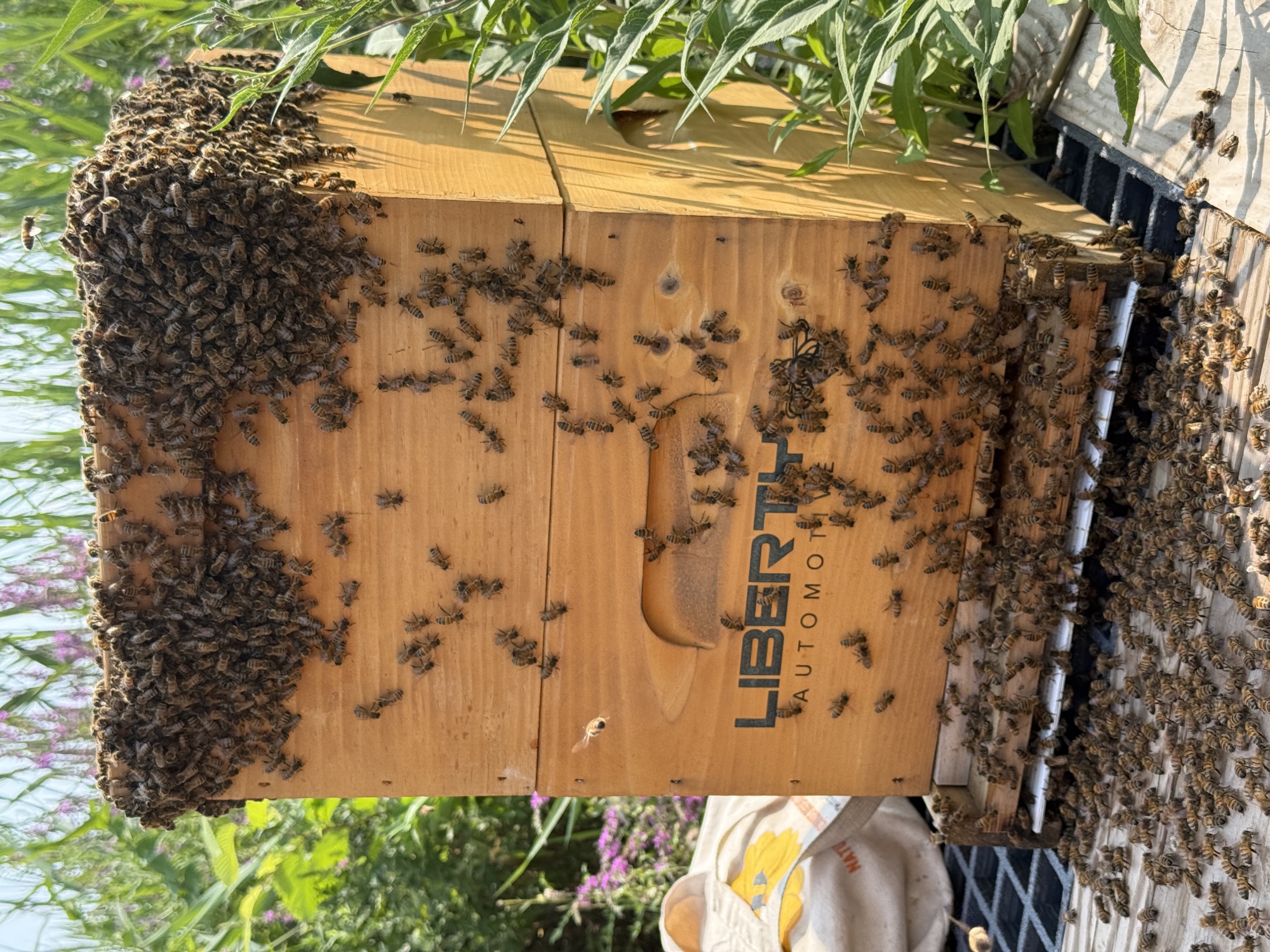
A worker bee born in summer lives about six weeks. She spends the first half of her life inside the hive, and the second half in the air, flying from flower to flower, trip after trip, from first light until the light gives out.
Add up everything she gathers in those weeks, every trip, every flower, and it comes to about one twelfth of a teaspoon of honey. Not a jar. Not a spoonful. A twelfth of a teaspoon, roughly one good drip.
So the jar you take home from our campus harvest is not the work of a bee. It is the work of hundreds of bees, thousands of foraging trips, and more flower visits than we can honestly count. The colony makes it possible because no bee tries to make the jar alone.
Your jar is the life work of hundreds of bees. Nobody at the counter will rush you.
We think about that when the shelf runs low. It would be easy to buy honey from somewhere else and keep the program going year-round, but that would miss the point. The jars run out because real work takes time, and the bees do not cut corners. Neither do we.
When you get your jar, have a look at the label. It tells you which hive it came from. Somewhere in that hive, several hundred bees each contributed their twelfth of a teaspoon, and every single one of them would do it again.