
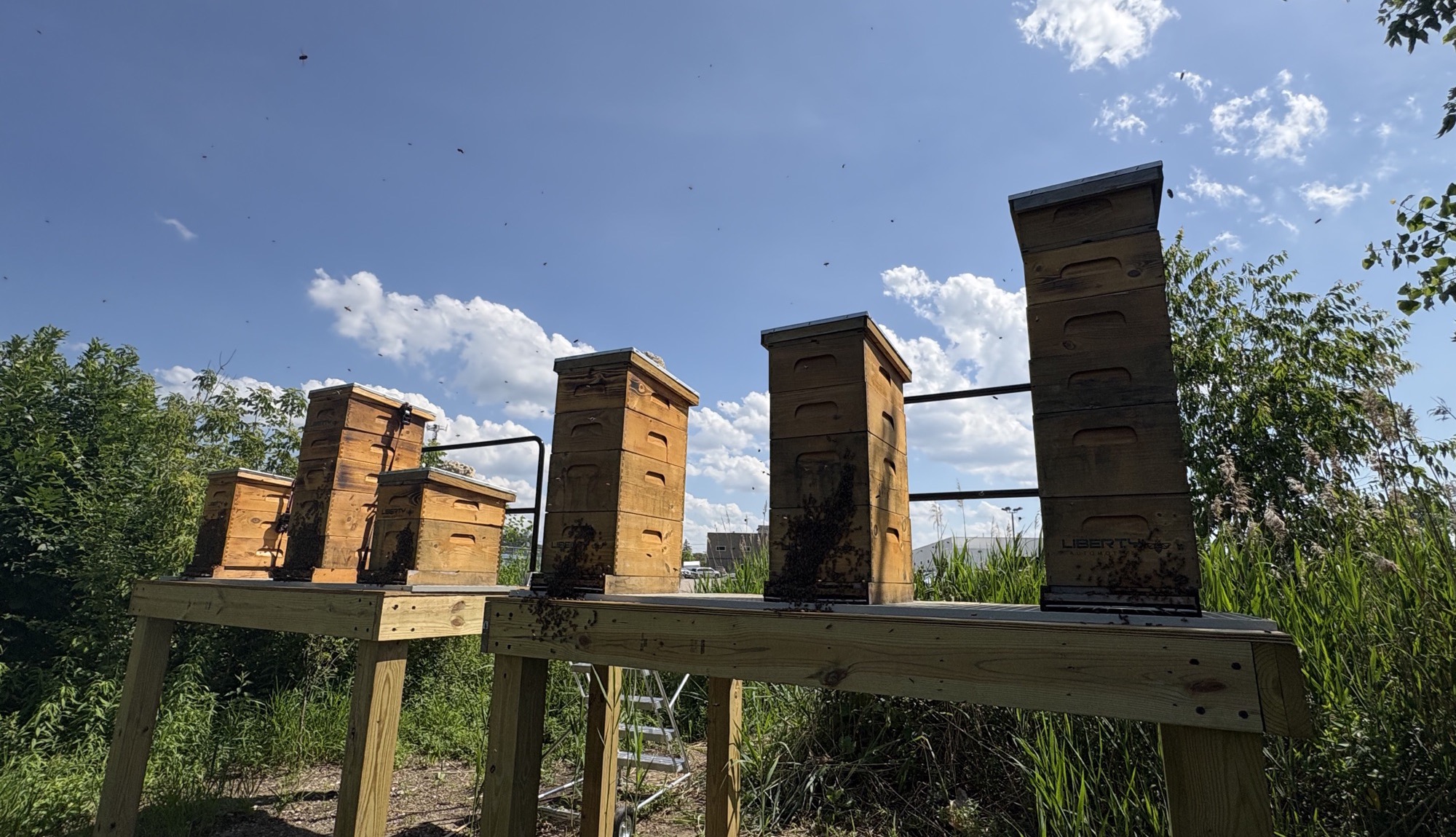
If you see honey bees wrestling at the front door of a hive this time of year, you are almost certainly watching robbing. Once the nectar dries up in the fall, foragers from strong colonies go looking for easier sugar, and the easiest sugar is honey another colony already made. The guard bees at the entrance fight back, and that scuffle is what catches your eye.
Beekeepers call the dry stretch a nectar dearth. University of Florida IFAS Extension notes that honey bees (Apis mellifera) are less likely to rob when nectar is available and more likely to rob when it is scarce. Around Libertyville that moment comes in early fall, when the goldenrod is spent and the last asters are fading, but every colony still has a big crew of experienced foragers with nothing left to forage.
A robbing hive is easy to spot once you know the signs. UF lists an unusual crowd of bees circling outside the box, bees trying to slip in where two boxes meet, fighting at the entrance, and shredded wax cappings on the ground below. Robbers keep at it until the source is gone, and a weak colony can lose all of its honey in a matter of hours or days.
Honest work makes the honey. Robbing only moves it from one hive to another.
The damage can travel, too. In a 2019 study, Cornell researchers David Peck and Thomas Seeley set healthy colonies 1, 50, and 300 meters from hives that were collapsing under Varroa mites. When the failing hives were robbed in late September and early October, mite levels jumped in the healthy colonies, even the ones 300 meters away. The authors decided a dying hive is less a mite bomb than a robber lure.
That is why fall beekeeping comes down to small chores. Beekeepers fit an entrance reducer so guards have a narrow door to hold, and they keep honey, spare frames, and sugar syrup covered so the smell does not draw a crowd. We like that a colony gets through an Illinois winter on honey it made itself. It is not a bad rule for a family business either: earn it honestly, price it fairly, and leave the neighbors' honey alone.