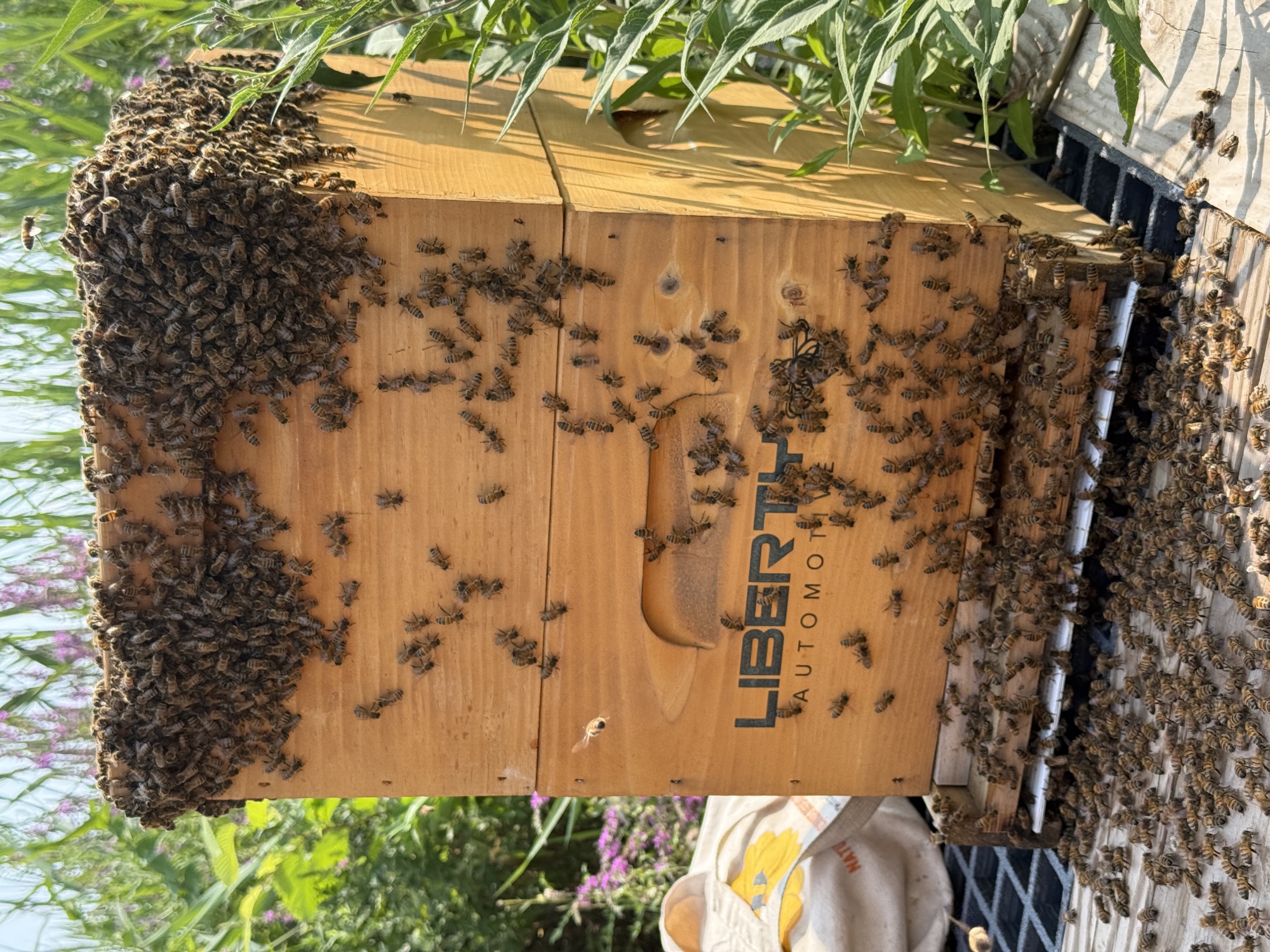
Stand near one of our hives on a warm afternoon and you will see bees landing with what looks like dark amber gum packed onto their back legs. That is not pollen. It is resin, scraped from tree buds and bark, and the bees will spend the rest of the day working it together with wax and their own enzymes into a substance called propolis.
Propolis is the building material of the hive. Bees use it to seal cracks, smooth rough wood, narrow the entrance down to a door they can defend, and glue the frames in place tight enough to make a beekeeper work for them. Given the chance, they will also coat the entire inside of the cavity with a thin layer of it. Beekeepers call that layer the propolis envelope.
The envelope is more than caulk. Plant resins are naturally antimicrobial, and researchers have found that colonies living inside a propolis envelope run their immune systems at a lower idle than colonies without one. The protection sits in the walls, so the bees spend less of their own energy fighting off trouble one bee at a time.
Bees build the protection into the walls, not into the apology afterward.
Propolis also handles the problems that cannot be carried out the front door. If a mouse gets into a hive over the winter and the bees kill it, they have no way to drag it outside, so they seal it in propolis and leave it where it lies. Nothing rots. Nothing spreads. The colony finishes the problem instead of working around it.
That is a fair description of how we try to run things a few minutes down the road in Libertyville. Do the quiet maintenance before it turns into a crisis, put the protection where the guest never has to think about it, and keep the price exactly where we said it would be, at MSRP or under, every time. A hive earns its safety by sealing its own walls. We would rather earn our trust the same way.