
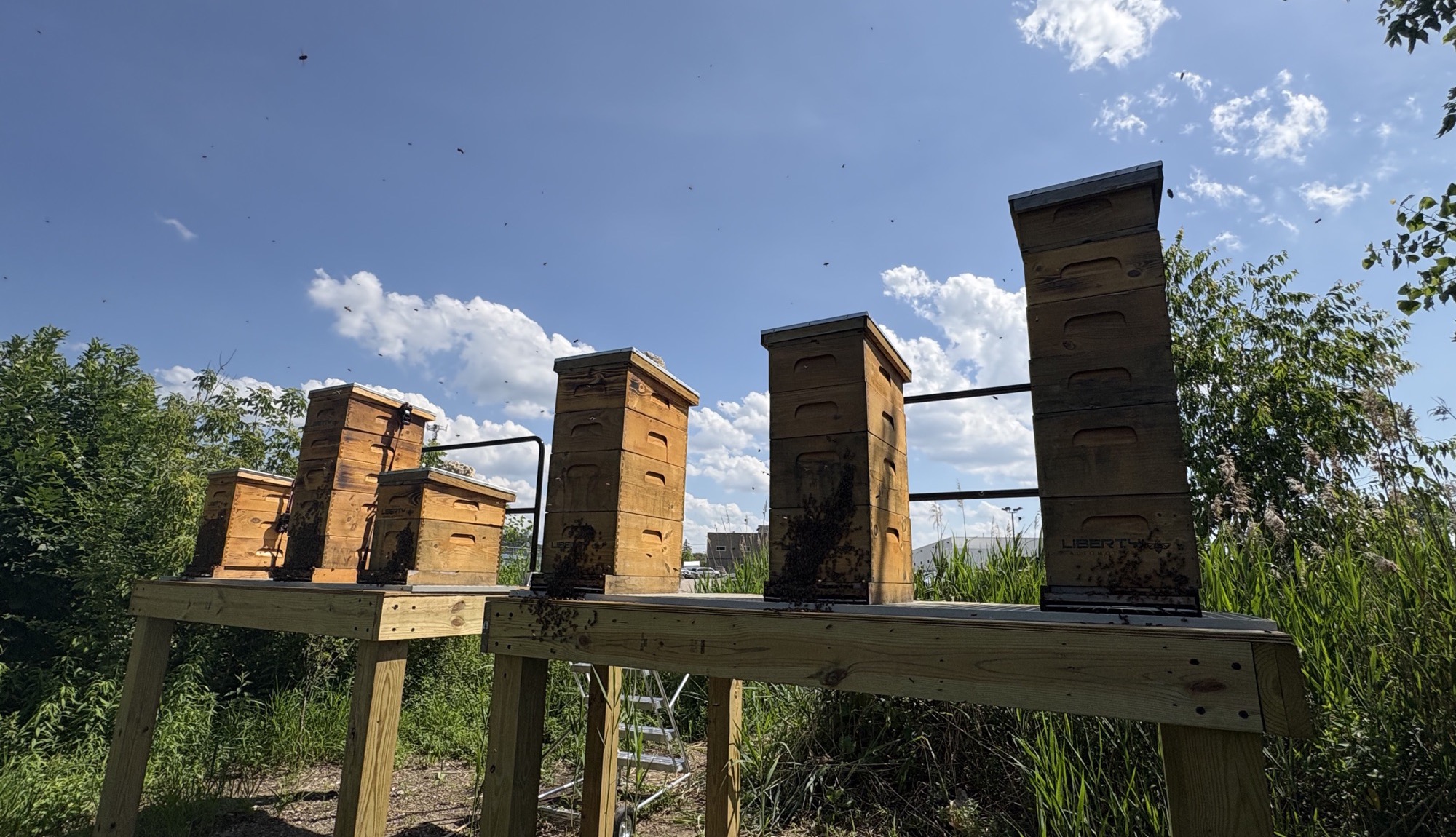
When a bee lifts off one of our hives and heads for a field, she is not seeing the field you and I see. Honeybees are trichromatic the way we are, but their three receptors are tuned to ultraviolet, blue, and green instead of red, blue, and green. Their range runs from roughly 300 to 650 nanometers, which means they see well down into the ultraviolet and stop seeing before they ever reach red.
So a red flower reads as something close to black to a bee. Meanwhile ultraviolet, the part of the spectrum that is completely invisible to us, is doing most of the talking. A great many flowers carry patterns in that range, and those patterns are not decoration.
Botanists call them nectar guides. Photograph a plain yellow sunflower or an evening primrose under ultraviolet light and a bullseye jumps out, a dark target ringing the center of the bloom. To a bee it works like a painted landing strip. Land here, and the nectar is exactly where the sign said it would be.
A flower that marks the spot gets visited again. So does a dealership that prints the price.
The bee eye is fast, too. Honeybees resolve flicker somewhere in the range of 200 to 300 times a second, where a human eye gives up near 60. Flying at speed through hedgerow and tall grass, she sees individual leaves as separate objects instead of one green smear, which is how she covers ground that would put the rest of us in a ditch.
We think about that bullseye more than you would guess. A flower that hid its nectar guide would waste everyone an afternoon, and a flower that paints one gets visited again tomorrow. That is the whole argument for printing our price where you can find it before you have to ask, at MSRP or under, every time. Mark the spot honestly and the right people keep coming back to it. That has worked for the flowers around Libertyville for a long while, and it works for us.